

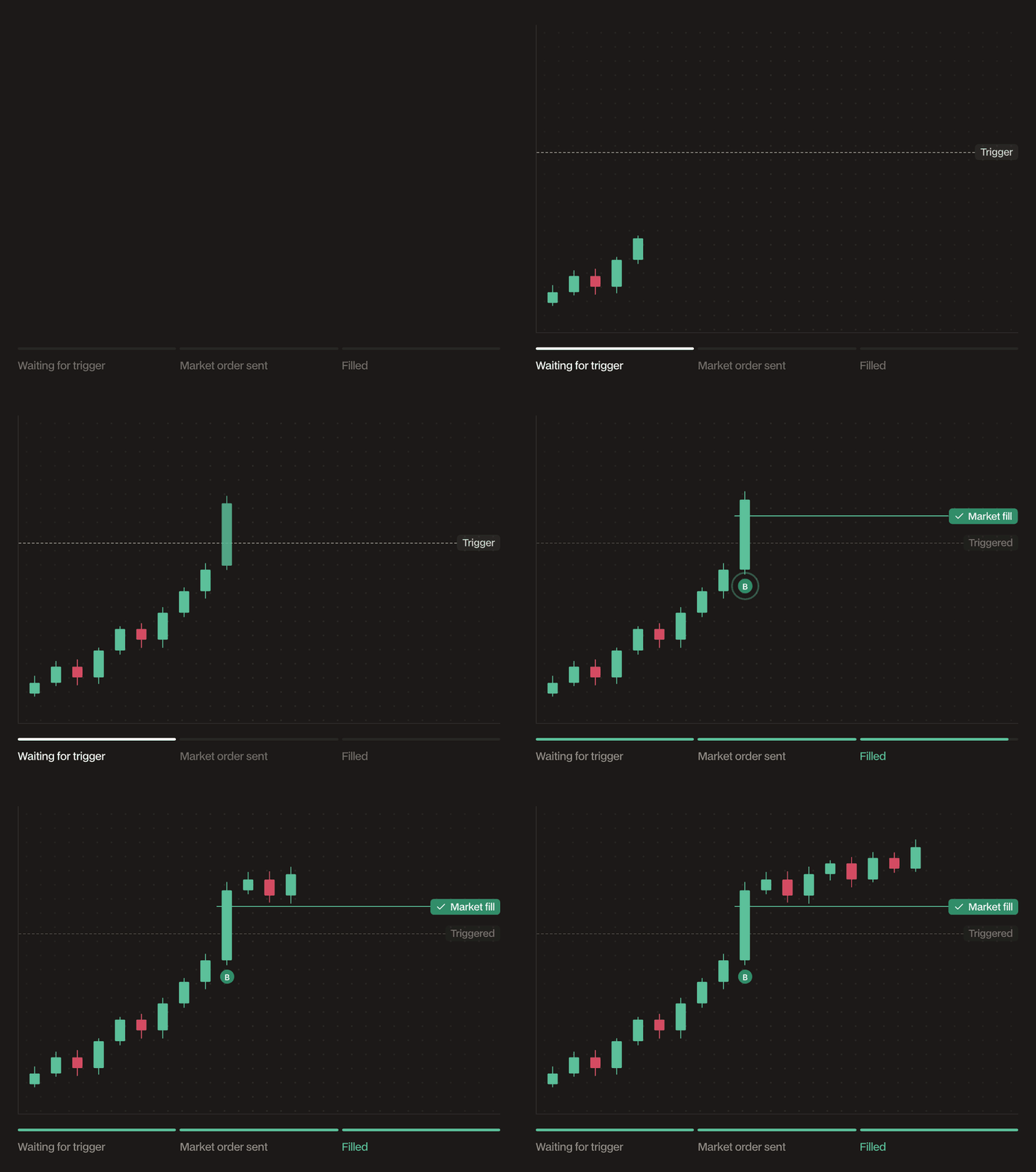
Stop Market
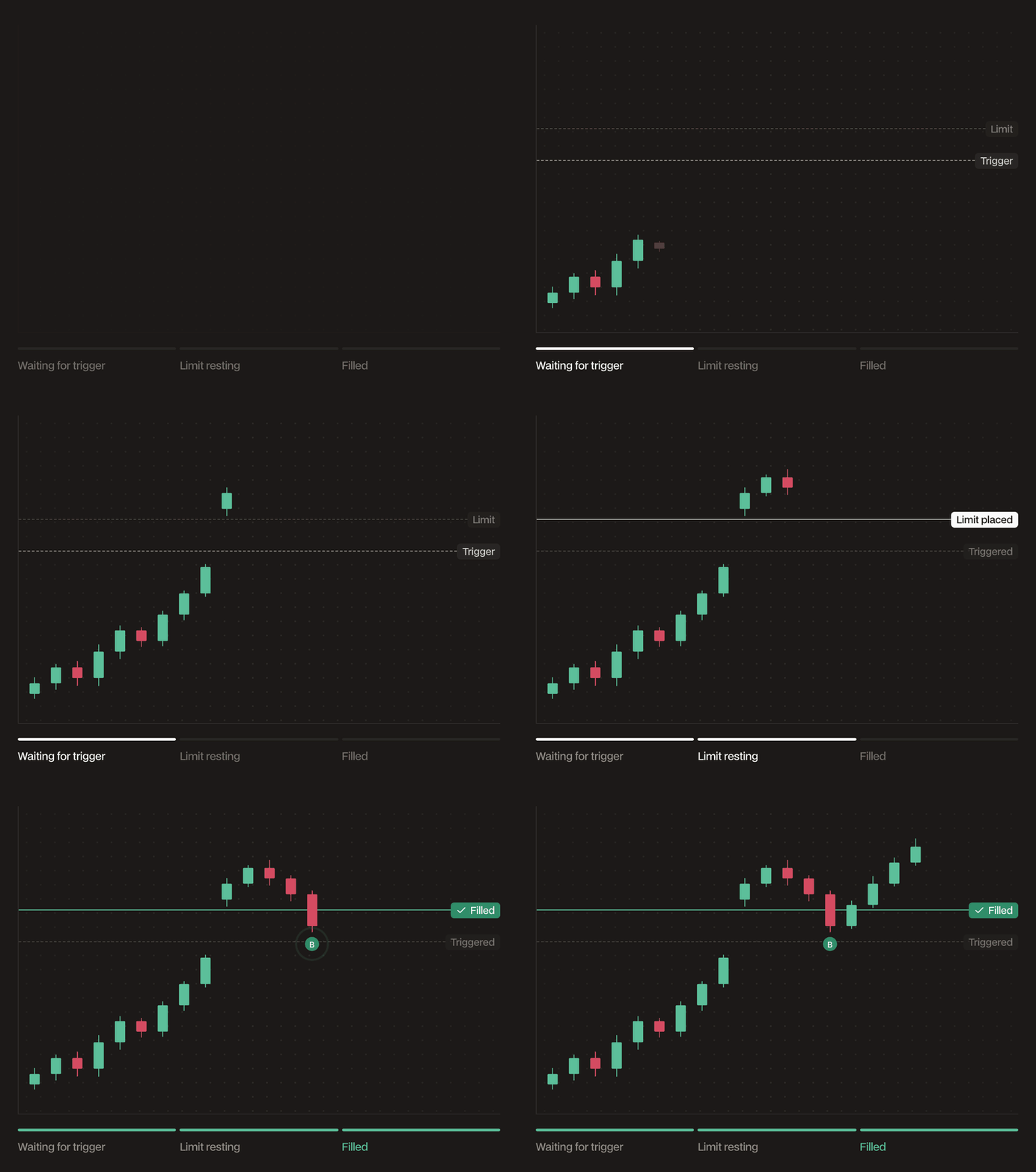
Stop Limit
How it places orders
- No trade executes at submission. The order waits until the asset price reaches your stop price.
- The direction is set when you enter the stop price: a stop above the current price triggers when price rises to it, and a stop below triggers when price falls to it. The form confirms it, for example “Triggers when the price rises to $120,000.”
- With Stealth on, the stop can sit on either side of the current price. With Stealth off, it must sit above the current price for buys and below it for sells, so a buy below or a sell above needs Stealth on.
- If price has already reached your stop before you submit, the form asks you to enter a new stop price.
- With Stealth on (the default), Hyperdash infrastructure watches the top of the book and places the order only once triggered, keeping your level hidden until then. With Stealth off, the stop is placed publicly on-chain as a trigger order the moment you submit it.
- Market: at trigger, a market order for the full size executes immediately, taking liquidity at the best available prices until filled, bounded by an 8% slippage cap. The fill price is not guaranteed, and in fast or thin markets the average fill can be worse than your stop price.
- Limit: at trigger, a limit order at your limit price is sent to the book and fills at that price or better. If price gaps through your limit, the order rests unfilled until price trades back or you cancel it. Hyperdash does not reprice or cancel it for you.
- TWAP or Chase TWAP: at trigger, a TWAP or Chase TWAP starts and runs over the duration you set. These always run with Stealth on.
- While a Stealth order is still waiting, you can edit its size, stop price, and limit price. Once it triggers, it can no longer be edited.
When to use it
- Trade breakouts: buy above resistance or sell below support, only once the level breaks.
- Protect a position with a hard exit at a defined level. Enable Reduce Only so the order can only close your position.
- Choose Market when missing the move costs more than a few ticks of slippage, and Limit when your worst acceptable price matters more than certainty of the fill.
Parameters
Examples
Conditional limit. BTC trades at $117,400 and you want to buy a breakout above $120,000 without paying up. You set stop $120,000, limit $120,250, size 0.5 BTC. When BTC hits $120,000, a limit buy at $120,250 is placed and fills at that price or better. If BTC gaps straight to $120,600, the order rests at $120,250 unfilled. Conditional market. You are long 400 HYPE from $41.00. HYPE now trades at $44.00, with support at $42.50, and you want out if support breaks. You set Order Type to Market, stop $42.00, size 400 HYPE, Reduce Only on. The form confirms: “Triggers when the price falls to $42.00.” If HYPE drops to $42.00, a market sell for 400 HYPE executes immediately and closes the position, for example at an average of $41.96 in a normal book, keeping about $384 of profit.Market guarantees the exit, not the price. Limit guarantees the price, not the exit. Size the gap between your stop and your limit for the market’s volatility so a fast move cannot jump both.